
How Much Will Your Plan Actually Cost? What a Business Budget Should Tell You
The business, owner and figures in this article are an illustrative composite, invented to show how budgeting works. They are not a real Sunstone Ledger client.
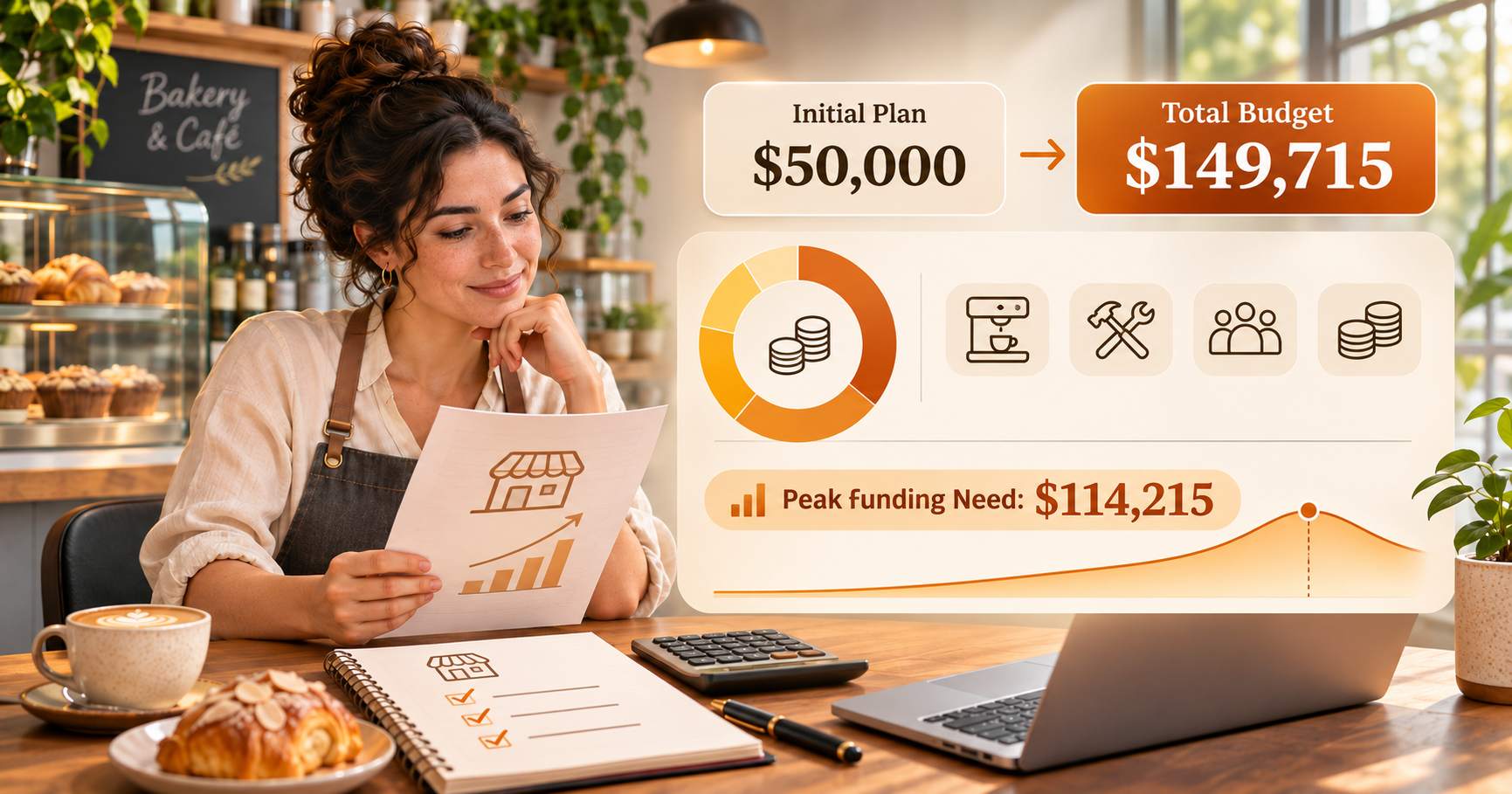
The equipment estimate was $50,000. The full six-month budget, including money set aside for surprises, was almost $150,000. Both numbers were correct. They just answered different questions.
Nadia has run a neighborhood bakery for six years. She wants to add wholesale deliveries to local cafés and offices. Two of the three café owners she has spoken to say they would try her bread and pastries.
She has already priced the equipment. A used refrigerated van, $22,000. A second deck oven with a proofer, $20,000. A larger mixer, $8,000. Fifty thousand dollars in total, and she has about $55,000 in the business account that she is prepared to use.
So she asks: Can I afford this?
It is a reasonable question. It is also the second question. The first one is what will this plan actually require? Until that has an answer, "can I afford it" is a comparison between a bank balance and a number nobody has calculated.
The plan, written down as a budget
An intention becomes a financial decision only after someone puts a price, a schedule and assumptions around it. That is the job of a business budget, whether the plan covers a full company, a quarter or one small project.
Here is Nadia's wholesale launch after the first six months of costs have been priced:
| Component | What it covers | Amount |
|---|---|---|
| Equipment | Van, oven, mixer | $50,000 |
| Setup and compliance | Oven installation and ventilation, permits, van outfitting, insurance down payment, one-time packaging design and labeling setup, catalog and samples, trial batches, hiring | $23,400 |
| Contingency held in reserve | 10% of one-time costs; not assumed to be spent | $7,340 |
| People | Production baker from Month 2; part-time delivery and sales coordinator from Month 3 | $37,400 |
| Running costs | Software, insurance, fuel, trade marketing, added utilities | $12,600 |
| Ingredients and packaging | For the product actually sold, at 33% of wholesale billings | $18,975 |
| Planned cash spending, Months 1–6 | Excludes unused reserve | $142,375 |
| Total budget envelope, including reserve | Planned spending + protected contingency | $149,715 |
The equipment Nadia had priced is only about one-third of the full budget. The difference is not a mysterious fee: installation, staffing, ingredients and the work of getting a new service operating all require resources. The $7,340 contingency is an amount to keep available, not a check that has already been written. A budget must distinguish planned spending from an untouched cushion.
Nadia did not misprice the van. She estimated the most visible part of the expansion. That distinction matters: an equipment quote is not a project budget.
Money leaves before it arrives
The total is only half of the answer. The other half is when.
| Month | Wholesale invoices | Cash collected | Actual cash paid | Cumulative cash gap | Funding needed with reserve |
|---|---|---|---|---|---|
| 1 | $0 | $0 | $36,800 | $36,800 | $36,800 |
| 2 | $0 | $0 | $41,160 | $77,960 | $85,300 |
| 3 | $6,000 | $0 | $14,840 | $92,800 | $100,140 |
| 4 | $12,000 | $6,000 | $14,820 | $101,620 | $108,960 |
| 5 | $17,500 | $12,000 | $16,635 | $106,255 | $113,595 |
| 6 | $22,000 | $17,500 | $18,120 | $106,875 | $114,215 |
| Total / final | $57,500 | $35,500 | $142,375 | $106,875 | $114,215 |
The contingency is first held aside in Month 2; the funding-needed column includes the same $7,340 reserve from that point onward, without treating it as a payment.
Wholesale customers pay on 30-day terms, so the $57,500 Nadia invoices by Month 6 becomes only $35,500 of cash in hand. The largest uncovered cash gap from actual payments is $106,875. If Nadia also keeps the $7,340 contingency untouched, the peak funding requirement is $114,215 at the end of Month 6. That is more than twice her original equipment estimate and $59,215 above the $55,000 she was prepared to commit. This is a planning requirement for a new activity, not a statement about the bakery's total available credit or cash elsewhere.
The budget does not tell Nadia to drop the plan. It lets her choose with the real number in front of her: phase the purchases, time the hire differently, arrange funding before she needs it, or change the scale. Those decisions are hers. What changes is that she makes them before the van is bought, not in Month 4.
What the plan has to achieve
A budget is not only a list of costs. It carries revenue and funding assumptions, which means it also carries a financial target. Nadia's plan assumes wholesale billings reach $22,000 a month by Month 6. The budget lets you read what that target actually means:
- With ingredients at 33% of billings and $10,860 of fixed monthly costs, the line breaks even at roughly $16,200 of billings a month. The plan crosses that in Month 5.
- At the planned $22,000, the line leaves $3,880 in a steady month after the illustrated operating costs, but before financing costs, income taxes, future capital spending and changes in working capital. That is not immediate recovery of the $114,215 funding commitment.
The planned sales level covers the illustrated ongoing operating costs. It does not erase the money needed to reach that level, nor does it establish an investment payback date. A professionally prepared budget keeps those questions separate.
Change one assumption and watch what moves
Another thing a budget does is show which assumptions carry the result. For Nadia it is not the price of the oven.
| Planning case | Peak funding required, including reserve | Difference from base |
|---|---|---|
| Plan as written | $114,215 | n/a |
| Sales ramp one month slower; costs start on schedule | $125,075 | +$10,860 |
| Cafés pay in 60 days instead of 30 | $132,335 | +$18,120 |
The equipment has not changed. Neither has the basic operating model. Timing alone changes the maximum funding requirement by roughly $11,000 to $18,000. The slower sales case reaches its peak in Month 7; the 60-day payment case also peaks in Month 7. These are simple, stated planning sensitivities, not claims about what customers will do.
A plan can make sense over a year and still run short of money in the month it needs to be carried out.
A business budget is bigger than a launch budget
When people hear the word, they picture a company-wide spreadsheet built once in January. That is one kind. The same discipline applies at several scales:
| Scale | The question it answers | Example |
|---|---|---|
| Whole business, for a year | What should the year look like, and what does it require? | Revenue targets, payroll, overhead and planned investments, month by month |
| Quarter or other period | What does the next 90 days need? | A seasonal inventory build; a quarter with heavy payroll or a large tax payment |
| Project | What will this specific plan require, and when? | Nadia's wholesale launch; opening a second location; a renovation; buying equipment |
| Campaign or initiative | What will this effort cost, and what does it need to return? | A spring promotion; a new service for existing customers; a hiring push |
These are not rival products. Nadia's wholesale project needs its own cost and funding picture. The bakery's annual budget has another responsibility: it must put that launch alongside existing retail sales, store payroll, rent, planned investments and the owner's overall targets. An annual budget might also be reviewed against actual results throughout the year. It is not just a one-time startup estimate.
At a smaller scale, a marketing initiative may need a budget for production, advertising, staff time and the results it is intended to deliver. At a larger scale, a full-company budget brings together departmental plans, resources and expected results. The method adapts to the decision; it is not limited to a single size of business.
Once a budget exists, you can also use it to look forward and ask what cash and results may look like if the plan goes ahead. That forward-looking question, where the business may be heading, is a separate discipline, and one that does not require a budget to begin with.
The number a good budget leaves you with
Nadia originally arrived with a shopping list. After budgeting, she has something different: a costed six-month plan, a timeline of payments, a funding requirement, a revenue threshold and assumptions she can challenge. She can decide to start smaller, move purchases, obtain financing or postpone. The budget does not make the decision for her; it makes the trade-offs visible.
The same principle applies to a business-wide annual budget. The deliverable is not simply a spreadsheet with a total at the bottom; it is a documented financial plan with a purpose, a period and a way to compare actual performance with the target.
When it is worth having someone build the budget
You do not need a professional budget for every idea. It is usually worth it when:
- you can describe the plan in a sentence but not in a number;
- your cost estimate has one or two lines, such as equipment, a lease or a hire;
- a lender, landlord, partner or investor will want to see the numbers;
- several initiatives would draw on the same cash at the same time;
- a previous project cost noticeably more than you expected.
How Sunstone Ledger approaches it
Sunstone Ledger is a bookkeeping practice for small businesses. Budgeting is a natural extension, because a useful budget starts from what your business actually does, not from what a template assumes.
For a scoped business or project budgeting engagement, we can combine your plan with reconciled QuickBooks records, expense patterns, staffing, margins and payment terms. The work product is a model the owner can read: what is included, expected timing, funding needs, target outcomes and the assumptions that matter. Depending on the scope, it can support an annual budget, a quarterly plan or a specific initiative. A completed budget can later support budget-versus-actual review.
That is separate from routine financial reporting. Reporting explains actual results; the budget states the financial requirements and targets of the plan.
If your records are behind or inconsistent, we would say so first. A budget built on unreliable history inherits the problem, and cleanup and catch-up bookkeeping may be the right first step.
The scope and price of each modeling engagement are agreed separately. A budget is not a guarantee of revenue, financing or profitability; it is not legal, tax or investment advice. Sunstone Ledger does not represent itself as a CPA firm or financial adviser. The business decision remains yours. We are based in Los Angeles and work remotely with small-business owners across the United States.
A plan with a price
A plan in words is an intention. A plan with a price, a timeline, a funding assumption and a target is something you can decide on, adjust or postpone on purpose.
If you have a plan, a project or an initiative but do not yet know what it will really require financially, Sunstone Ledger can turn the plan and your actual business numbers into a structured budget. Tell us about the plan in whatever form it exists (a paragraph, a list, a vendor quote) and mention whether you need an annual business budget or a budget for one project. We will explain what the proposed scope could cover and what records would be needed.
Frequently asked questions
Is a business budget the same as a cash flow forecast? No. A budget turns a plan into financial requirements and targets. A cash flow forecast projects how cash may move under a set of assumptions, whether or not a formal budget exists. They are related, and one can feed the other, but neither requires the other.
Do I need a budget for the whole company, or can you budget a single project? Either. Budgets can cover a full year, a quarter, a department, a single project such as opening a location or buying equipment, or one campaign. Many owners start with the one decision in front of them.
How accurate is a budget? A budget is as good as its assumptions, which is why we list them. It is not a prediction. Its value is showing what the plan requires, which assumptions drive the answer, and how the answer changes when one of them does.
What do you need from me? Access to your books, a description of the plan, and whatever you already have: vendor quotes, a hiring idea, a lease proposal, expected timing. Rough is fine. If the books need work first, we will tell you.
Will a budget help me get a loan or financing? A clear budget can help you explain what you need and when. Sunstone Ledger does not arrange financing, and we cannot promise any lender's decision.
This article is general information for business owners. It is not legal, tax, financial or investment advice. The example is illustrative and its figures are not typical results.
Related reading
A related Sunstone Ledger guide for business owners. The Payroll That Almost Didn't Go Out
A practical follow-up for cleaner books and decisions. Bookkeeping Services
See how Sunstone Ledger helps owners keep records current.