
The Payroll That Almost Didn't Go Out
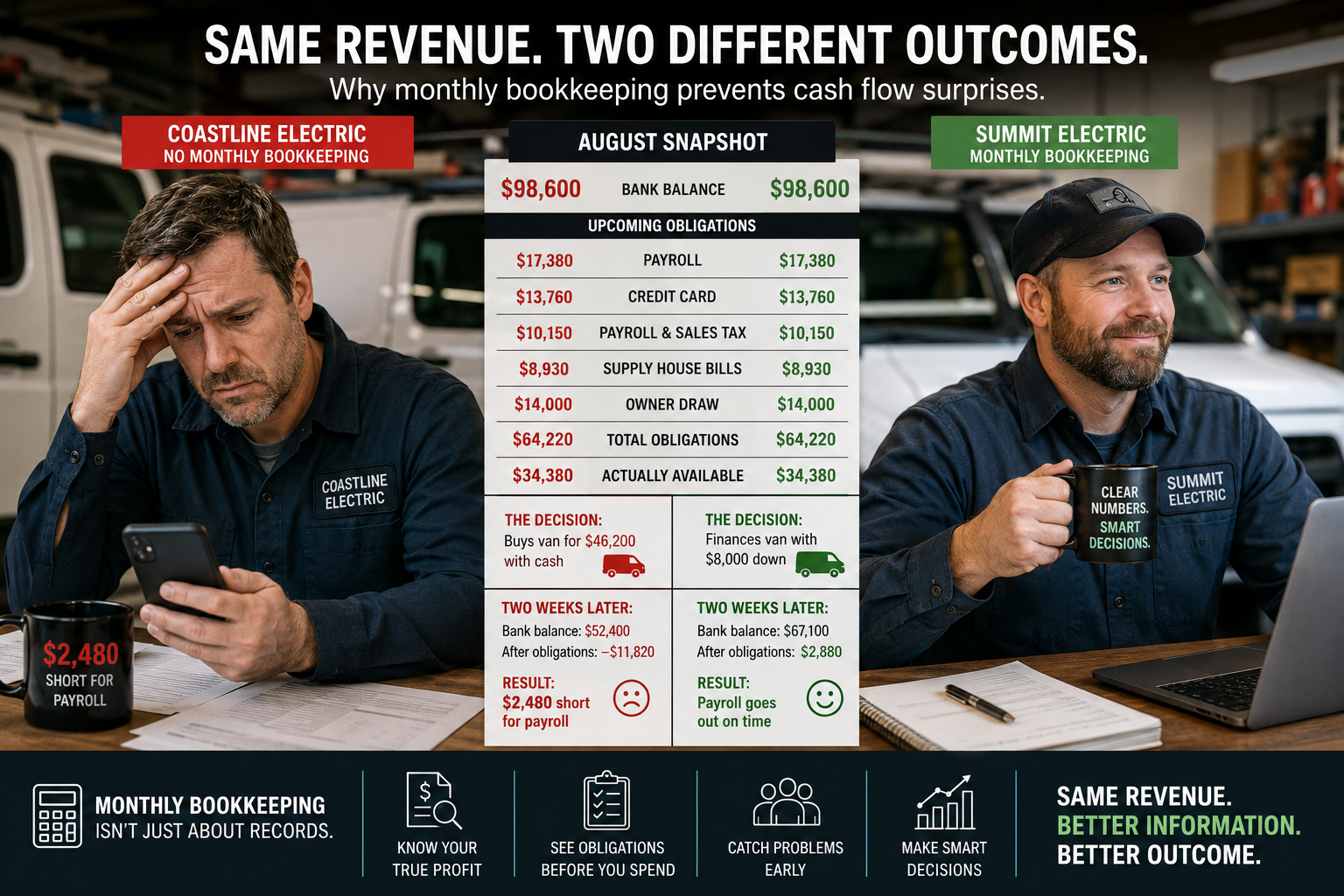
The case below is a composite, built from situations that come up regularly in small business bookkeeping around Los Angeles. It isn't a specific client's story — it's a breakdown of what a cash flow crunch actually looks like from the inside.
Michael owns Coastline Electric, an electrical contracting company doing residential and commercial work across LA. He has a CPA who files his taxes every year without a single penalty. His question on the first call with Sunstone Ledger is a fair one: "I've already got this handled. Why would I need a bookkeeper every month too?"
Eight months later, Michael is standing in his kitchen on a Friday morning, looking at a bank balance that's $2,480 short of what he needs to make payroll for three electricians.
Here's how he got there — step by step, in numbers.
Two Businesses, the Same Revenue
A few miles away, Summit Electric — owned by Andrew — does the same kind of work: panel upgrades, EV charger installs, electrical for commercial tenant improvements. Same revenue, roughly $600,000 a year. Three electricians on staff at each company, a couple of subcontractors, the same QuickBooks, the same CPA once a year.
There's exactly one difference:
| Coastline Electric (Michael) | Summit Electric (Andrew) | |
|---|---|---|
| Bookkeeping during the year | None — books get opened once a year, before filing | Closed every month by a bookkeeper |
| Bank and card reconciliation | No | Monthly |
| Who sees obligations before a decision | No one | The owner, before the money is spent |
In January, the two companies look identical:
| Coastline Electric | Summit Electric | |
|---|---|---|
| Revenue | $47,800 | $47,800 |
| Expenses | $36,900 | $36,900 |
| Profit | $10,900 | $10,900 |
At this point, Michael has every reason to think a monthly bookkeeper is just one more line item he can skip.
March: A $9,180 Purchase That Only Partly Made It Into the Books
Coastline Electric buys materials for a big job — panels, breakers, wire. The bank feed is connected to QuickBooks, but the sync only partially goes through that month.
| Actually spent | Landed in QuickBooks | Gap | |
|---|---|---|---|
| Supply house purchase, March | $9,180 | $6,240 | $2,940 |
Several transactions get stuck in a categorization queue and never make it into the report. Result: March profit in Coastline Electric's books comes in $2,940 higher than it actually is. At Summit Electric that same month, the bookkeeper reconciles the card statement line by line and catches the same stuck transactions in about 15 minutes.
April: Revenue Counted Twice
A longtime client — a property management company — pays an $11,400 invoice billed back in February. The money hits the bank, and Michael logs it in QuickBooks as a new sale.
| Recorded in QuickBooks | Actual April revenue | Gap | |
|---|---|---|---|
| Coastline Electric | $62,000 | $50,600 | $11,400 |
The problem: that $11,400 was already in the books, as accounts receivable since February. At Summit Electric, the bookkeeper simply matches the payment to the existing invoice instead of creating a new sale. Revenue stays at $50,600 — exactly what the business earned.
August: $98,600 in the Bank — and a Decision to Buy a Van
By late summer, Coastline Electric has $98,600 in the bank. The old service van has started acting up — a cracked fuse panel, morning jobs increasingly derailed. Michael looks at the balance, looks at year-to-date profit on the report — already $134,200 — and decides to buy a new van with diagnostic equipment for $46,200.
The problem is that the $98,600 on his phone is already partly spoken for over the next few weeks:
| Upcoming obligation | Amount |
|---|---|
| Payroll for three electricians | $17,380 |
| Business credit card balance | $13,760 |
| Payroll and sales tax | $10,150 |
| Bills from the supply house | $8,930 |
| Planned owner distribution | $14,000 |
| Total obligations | $64,220 |
| Bank balance | $98,600 |
| Actually available | $34,380 |
Andrew, at Summit Electric, has roughly the same $98,600 in the bank. He's shopping for a van too. But he has this same table, from his bookkeeper — with a note that $13,500 from that same property management client is more than 60 days overdue and shouldn't be counted on yet. Andrew decides to wait six weeks until the overdue invoice clears, and ends up financing the van with an $8,000 down payment instead of paying the full amount in cash.
Michael pays the $46,200 in cash, straight from the business account.
| Before the purchase | After the purchase | |
|---|---|---|
| Bank balance | $98,600 | $52,400 |
| Actually available after obligations | $34,380 | −$11,820 |
That number on the right isn't a cushion anymore — it's a deficit. It just isn't visible yet. Payroll is two weeks away, and everything still looks fine.
The Friday Michael Won't Forget
The next two weeks go the way they normally do: materials for ongoing jobs, bills that need to go out to protect his net-30 terms with the supply house. By the Friday a $17,380 payroll is due, the account is down to $14,900.
| Amount | |
|---|---|
| Needed for payroll | $17,380 |
| Available in the account | $14,900 |
| Shortfall | $2,480 |
Michael had been counting on $13,500 from that same property management client — they usually pay two to three weeks late, but they pay. This time, nothing came in. He's told a check will go out "next week." That doesn't help today.
He closes the gap three ways:
| Source | Amount | Cost |
|---|---|---|
| Personal savings | $1,500 | — |
| Extension on an $8,930 supply house bill | — | First time asking in three years |
| Short-term advance from an online lender | $3,000 | $600 in fees over 30 days (~240% annualized) |
Payroll goes out two days late. Marcus, an electrician who's been with Michael for three years, asks him directly: "Are we good on money?" Technically, yes. In practice, it's the first time Michael can't answer that question with real confidence.
What Built Up All Summer Without Anyone Noticing
While the van story was playing out, two other things were quietly growing in Coastline Electric's books.
Software spending:
| January | July | Monthly gap | |
|---|---|---|---|
| ServiceTitan, QuickBooks, CAD licenses | $1,180 | $1,930 | $750 |
The old ServiceTitan plan never got cancelled during an upgrade, and two user licenses stayed active for electricians who no longer work there. Over six months, that's an extra $4,500 nobody consciously decided to spend.
Personal expenses never entered into the business's books:
| Item | Amount |
|---|---|
| Hotel in San Diego, 2 nights | $1,380 |
| Set of tools | $2,150 |
| Dinner with a general contractor | $410 |
| Office supplies | $640 |
| Total | $4,580 |
All paid on Michael's personal card. The company's expenses were understated by exactly that amount, and the profit on the report was inflated by the same.
At Summit Electric, both of these surface naturally: the bookkeeper sees the subscription creep in the report and asks if it's expected; sees a hotel charge on Andrew's personal card and checks whether it was a business trip. All Andrew has to do is answer.
Where Things Stand by September
| Coastline Electric (reported) | Actual profit | |
|---|---|---|
| Profit through September | $134,200 | $115,300 |
| Gap | $18,900 |
That's not money that was stolen or lost. It's the sum of small gaps nobody checked over the course of a year — and $134,200 is exactly the number sitting in front of Michael the moment he decided to buy the van.
December: The CPA Gets Two Very Different Folders
Both companies have a good CPA. What each one hands over is different.
Coastline Electric shows up with a year of unreconciled numbers: what was that $11,400 deposit in April, why doesn't the card balance match, where are the receipts for personal expenses. The CPA either spends extra billable time cleaning up the books, or sends Michael back to sort it out himself.
Summit Electric shows up with twelve closed months: reconciled accounts, a clean P&L, transactions that already make sense. The CPA works with finished data.
A monthly bookkeeper doesn't replace a CPA. It makes the CPA's work faster, cheaper, and more accurate.
What This Actually Costs
| Line item | Coastline Electric (no bookkeeper) | Summit Electric (monthly bookkeeper) |
|---|---|---|
| Monthly bookkeeping, $450 × 12 | — | $5,400/year |
| Year-end cleanup before filing | $2,500 | — |
| Short-term advance fee (payroll rescue) | $600 | — |
| Total direct cost | $3,100 | $5,400 |
In dollars, the difference is about $2,300 a year — not $20,000, the way this service sometimes gets marketed. But August is the part that matters more than the dollars: whether you can make a decision about a major purchase knowing the real picture, instead of the one that looks fine on your phone.
What an Owner Is Actually Buying for $450 a Month
Not "someone entering transactions." What they're buying is the ability to honestly answer five questions every month — before the decision, not after:
- What did the business actually earn — not the balance, the profit?
- Who do we owe — credit cards, vendors, taxes, payroll?
- Who owes us — and how much of that is overdue enough that we shouldn't count on it in the next few weeks?
- Where have expenses started creeping up?
- Can we actually afford a major purchase right now, or does it just look that way?
The Bottom Line
Coastline Electric and Summit Electric earned the same real profit. The difference isn't the economics of the business — it's visibility. One owner knew the real numbers at the moment he decided to spend $46,200 on a van. The other found out only once payroll was already on the table and the money wasn't there.
| On the phone screen | In reality | |
|---|---|---|
| August balance | $98,600 | $98,600 |
| Actually available after obligations | — | $34,380 |
| After the $46,200 van purchase | $52,400 | −$11,820 |
Both numbers on every line are true. The gap between them is what a cash flow crunch actually is.
Want to know how much of your business's cash is actually free to spend right now — before the decision is already made? Book a free consultation with Sunstone Ledger →
Frequently Asked Questions
What is a cash flow crunch, and why does it happen to profitable businesses? A cash flow crunch is when a business physically doesn't have enough cash on hand to cover current obligations, even if it's profitable overall. It happens when an owner tracks the account balance instead of the gap between that balance and known upcoming obligations.
What's the difference between a monthly bookkeeper and a CPA? A CPA mainly handles tax filing, typically once a year. A monthly bookkeeper closes the books every month during the year and keeps the numbers accurate on an ongoing basis — which makes real obligations visible before they become a problem.
How much does monthly bookkeeping cost for a small business in Los Angeles? Typically $300–$600 a month for a service or contracting business earning $500,000–$700,000 a year, depending on transaction volume.
Can a big purchase trigger a cash flow crunch on its own? Yes, if the decision is based on the account balance rather than the full picture of obligations. Even a profitable business can come up short on payroll two or three weeks after a large purchase.
Related reading
A related Sunstone Ledger guide for business owners. 1099 and W-9 for Contractors: A Simple Process That Avoids January Panic
A practical follow-up for cleaner books and decisions. Bookkeeping Services
See how Sunstone Ledger helps owners keep records current.