
1099 and W-9 for Contractors: A Simple Process That Avoids January Panic
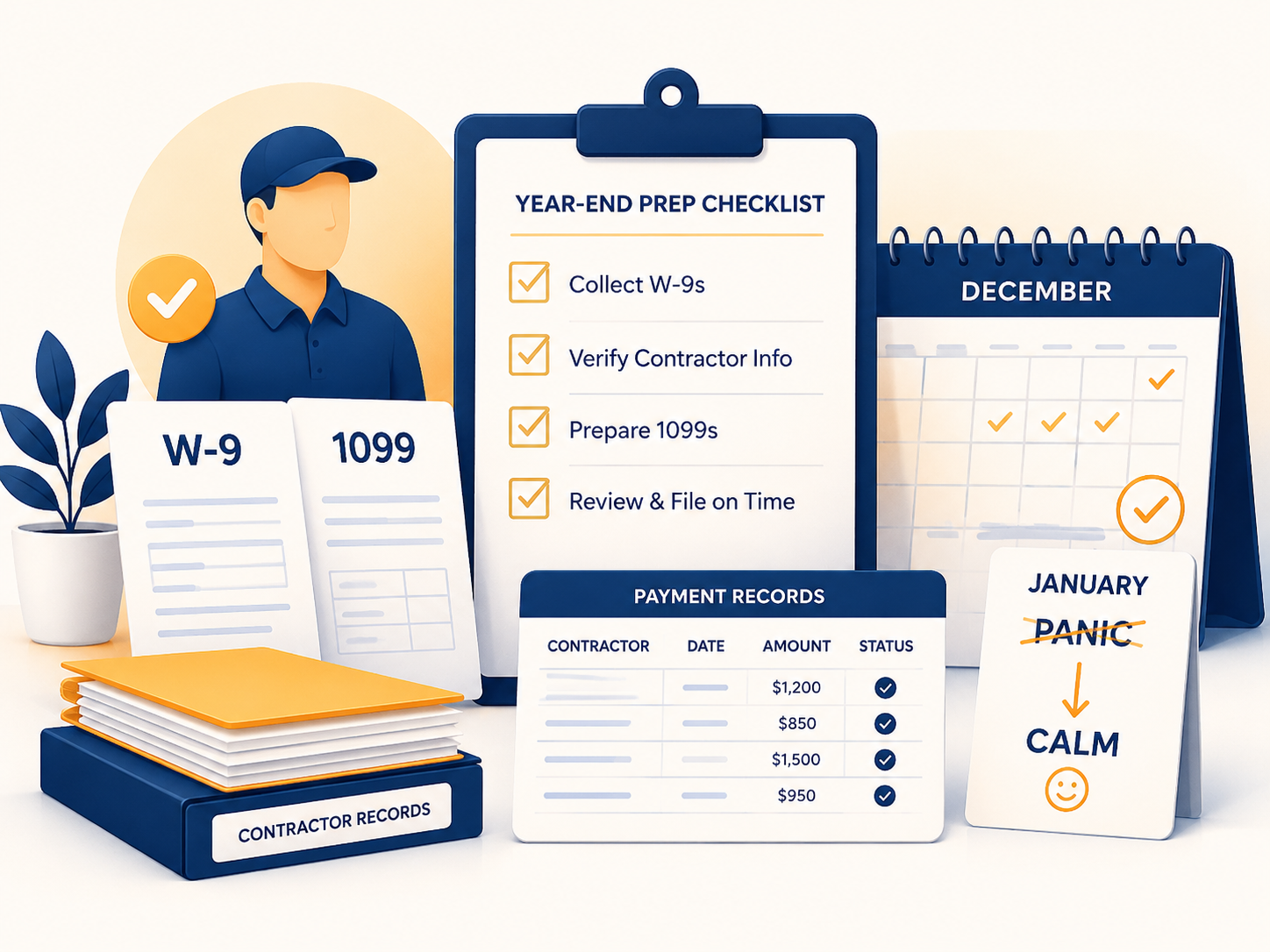
January becomes stressful for many business owners because 1099 work is treated like a January project. In reality, it should be a simple year-round bookkeeping habit. The hard part is not only preparing the form. The hard part is collecting the right information early, tracking contractor payments cleanly, and keeping reimbursements separate from compensation.
Form W-9 and Form 1099 are connected, but they do different jobs. A W-9 is the information form you collect from a contractor. It gives you the legal name, business name if applicable, tax identification number, address, and tax classification. A 1099 is the year-end information return that may need to be sent later when reportable payments meet the filing rules for the year.
The mistake many owners make is waiting until January to ask contractors for W-9s, clean up vendor names, separate reimbursements, and confirm totals. By then the work becomes rushed. Contractors may not respond quickly. Payments may be buried in bank feeds. Some amounts may include both labor and reimbursed costs. The result is panic, rework, and a higher risk of incorrect forms.
The simple rule: collect before you pay
The cleanest 1099 process starts before the first payment. If someone is being paid as an independent contractor, request a completed W-9 before work begins or before the first payment is released. This is not about being difficult. It is about protecting the business from a year-end scramble.
When the W-9 is collected early, the business already has the contractor's legal name, address, tax ID, and tax classification. That information can be entered into QuickBooks or the vendor record once, then used throughout the year. If the W-9 is missing, the business may still pay the contractor, but it is creating a future problem that will likely come back in January.
Payment thresholds and filing rules can change, so the final 1099 decision should be checked for the specific tax year before forms are filed. But the operational habit does not change: collect the W-9 early, store it safely, track payments correctly, and review totals before year-end.
W-9 vs 1099: what each form does
| Item | When it is used | Why it matters |
|---|---|---|
| Form W-9 | Collected from the contractor before or near the start of the relationship. | Provides the legal name, tax ID, address, and tax classification needed for year-end reporting. |
| Form 1099 | Prepared after year-end when payments meet the reporting requirements for the year. | Reports qualifying payments to the contractor and the tax authorities. |
| Vendor record | Maintained inside the bookkeeping system throughout the year. | Keeps names, addresses, payment categories, and 1099 tracking consistent. |
Think of the W-9 as the source document. It should not live only in someone's inbox. It should support the vendor setup in the bookkeeping system and be easy to find when year-end review begins.
Who should be treated as a contractor for this process?
This article is not about deciding whether a worker is legally an employee or an independent contractor. That is a separate and important question. For bookkeeping purposes, the year-round W-9 and 1099 process should be used for people and businesses you pay as outside service providers, freelancers, consultants, subcontractors, and other nonemployee service providers.
Common examples include designers, repair workers, marketing consultants, IT support, photographers, drivers, cleaners, subcontract labor, bookkeepers, professional service providers, and other vendors who are paid for services. Some vendors may not ultimately receive a 1099 depending on their entity type, payment method, amount, and current filing rules. Still, collecting a W-9 early is usually the safest workflow because it gives you the facts before January.
The worst approach is guessing. A vendor name in the bank feed may not tell you whether the payee is an individual, a single-member LLC, a partnership, a corporation, or a service paid through a third-party platform. The W-9 helps remove that guesswork.
What to collect before the first payment
A clean contractor setup does not need to be complicated. Before the first payment, collect the information that will be hard to chase later. The goal is to create one reliable vendor record from the beginning.
- Completed W-9. The form should include legal name, business name if different, tax classification, address, and tax identification number.
- Contact information. Keep a current email and phone number for payment questions and year-end follow-up.
- Service description. Note what the contractor does so payments can be categorized consistently.
- Payment method. Track whether payments are made by check, bank transfer, card, payment app, or another system.
- Written agreement or scope. Keep the contract, estimate, invoice terms, or written approval if available.
- Reimbursement rules. Decide how reimbursed expenses should be submitted, documented, and separated from contractor pay.
This information should be stored in a secure folder and reflected in the bookkeeping system. A W-9 includes sensitive tax identification information, so access should be limited to people who actually need it.
A process you can run all year
The best 1099 process is not a large year-end project. It is a small monthly habit. If the business reviews contractor payments every month, January becomes a final check instead of an emergency cleanup.
| Monthly habit | What to do | Why it prevents January panic |
|---|---|---|
| New vendors | Confirm whether the vendor is a contractor and request W-9 before payment. | You are not chasing missing tax IDs after the year is over. |
| Vendor records | Enter legal name, address, tax classification, and 1099 tracking status. | Names and addresses do not need to be corrected at the last minute. |
| Payment categories | Code contractor labor, materials, reimbursements, and owner payments separately. | 1099 totals are not inflated by unrelated payments. |
| Monthly review | Run a vendor payment review and look for missing W-9s or unclear names. | Problems are handled while the contractor is still active. |
This monthly review can be short. The owner does not need to read every transaction manually. The important question is simple: did we pay any new contractors this month, and do we have the information needed to report those payments correctly if required?
What to track in the bookkeeping system
Good 1099 preparation depends on clean vendor tracking. If payments are posted to generic names like “cash,” “Zelle,” “check,” or “contract labor” without a proper vendor, the totals will be difficult to review at year-end. Each contractor should have a consistent vendor name, and payments should be connected to that vendor.
The bookkeeping system should make it easy to see how much was paid to each contractor during the year, what category those payments used, how the payments were made, and whether a W-9 is on file. If a contractor changes address or business name, update the vendor record before year-end.
It is also important to separate different types of payments. Contractor labor, reimbursed expenses, materials, refunds, owner payments, and loan repayments should not all be treated the same. When everything goes into one bucket, year-end review takes longer and totals become less reliable.
Mini-scenario #1: the contractor refuses to provide a W-9 late
A small business hired a contractor in March and paid them several times during the year. The contractor did good work, invoices were paid on time, and nobody asked for a W-9 because the relationship felt informal. In January, the owner realizes that the contractor may need a 1099. The owner emails the contractor and asks for a completed W-9.
The contractor does not respond. Then they say they are busy. Then they ask why the business needs the form now. The owner sends another reminder, but the filing deadline is getting closer. The payments are already made, the contractor has less incentive to cooperate, and the owner now has a reporting problem that could have been avoided before the first payment.
The lesson is simple: collect the W-9 before the contractor has been fully paid. Once the work is complete and all invoices are paid, your leverage is much lower. A clear onboarding rule prevents this problem: no completed W-9, no first payment, unless the owner intentionally approves an exception.
Mini-scenario #2: reimbursements are mixed with contractor pay
A contractor charges $4,000 for services and also submits $1,200 of reimbursed expenses for materials, parking, and supplies. During the year, the business pays the contractor $5,200 and records the entire amount as contractor labor. In January, the 1099 review shows $5,200 as contractor compensation.
But that total may not reflect the actual service pay. Part of the amount was reimbursement for costs the contractor paid on behalf of the business. If those reimbursements were not tracked separately and documented clearly, the year-end total may be wrong or at least require extra review.
This is why reimbursement rules should be set early. The contractor should submit receipts or supporting details, and the business should record reimbursed costs separately from service compensation when appropriate. Clean separation during the year prevents inflated totals and back-and-forth questions in January.
Where January rework usually comes from
Most 1099 rework does not come from the form itself. It comes from unclear bookkeeping. When vendor records are incomplete or payments are posted inconsistently, the year-end review becomes a cleanup project.
- Missing W-9s. The business paid contractors but never collected legal names, addresses, or tax IDs.
- Duplicate vendor names. One contractor appears under several names, such as personal name, business name, and payment app name.
- Wrong payment categories. Contractor labor, supplies, materials, refunds, and reimbursements are mixed together.
- Unclear payment methods. Payments made by card, third-party networks, checks, and bank transfers are not separated for review.
- Personal payments mixed in. Owner transfers or personal reimbursements are posted to contractor categories.
- Old vendor information. Addresses and business names changed but were never updated.
- No monthly review. Problems that could have been fixed in May are discovered in January.
The solution is not to make January more intense. The solution is to make every month slightly cleaner.
How to review contractors before year-end
By November or early December, the business should run a contractor review. This gives time to fix missing information before January. The review should not wait until the books are fully closed for the year. It is better to identify missing W-9s early, even if final payment totals are not yet complete.
- List all vendors paid during the year. Focus on service providers and other possible contractors.
- Check W-9 status. Mark who has a W-9 on file and who does not.
- Review vendor names. Merge or correct duplicate vendor names before totals are reviewed.
- Check payment categories. Make sure contractor pay is not mixed with reimbursements, materials, owner payments, or transfers.
- Review payment methods. Confirm which payments need to be considered under current filing rules.
- Ask questions before year-end. Contact contractors while there is still time to receive updated information.
This review turns January into a final confirmation. The business still needs to close the year and verify final totals, but the biggest missing-information problems should already be known.
How to store W-9 forms safely
A W-9 contains sensitive information, including a tax identification number. It should not be stored casually in a shared inbox or a random desktop folder. Use a secure location with limited access. The folder structure does not need to be complicated, but it should be consistent.
A practical setup is one secure vendor folder with subfolders by year or by contractor. Save the W-9 using a clear file name, such as the legal vendor name and the year received. If the contractor sends an updated W-9, keep the newest version clearly marked. The bookkeeping system can note that a W-9 is on file, while the actual document stays in secure storage.
Do not send W-9 forms back and forth more than necessary. If documents must be shared with a tax preparer or 1099 filing provider, use a secure method rather than ordinary email whenever possible.
What to do this month
- Create a contractor list. Identify everyone paid for services this year.
- Check who is missing a W-9. Request the form now, not in January.
- Clean vendor names. Avoid duplicate records for the same contractor.
- Separate reimbursements. Do not mix reimbursed costs with service compensation without review.
- Review payment methods. Make sure payment type is clear before year-end review.
- Set a rule for new contractors. No W-9, no first payment, unless the owner approves an exception.
- Schedule a November review. Do not make January the first time anyone looks at 1099 readiness.
Related reading
How organized records make tax season easier and less rushed. Cleanup vs Catch-Up
Know whether your books need missing months completed or existing errors fixed. Bookkeeping Services
See how Sunstone Ledger helps owners keep records current.
Why this matters
1099 preparation is much easier when it is built into normal monthly bookkeeping. The business should not be guessing in January who was paid, how much was paid, whether the vendor name is correct, whether a W-9 exists, or whether reimbursements were mixed into contractor compensation.
A simple year-round process gives the owner cleaner reports, fewer last-minute questions, and a better handoff to the tax preparer or 1099 filing provider. It also protects relationships with contractors because the business asks for required information at the beginning, not after the year is already over.
If contractor payments, W-9 collection, and year-end review are not organized, Sunstone Ledger can help build a practical process and keep the books ready throughout the year. You can start with our bookkeeping services or review our pricing options.
Make 1099 season routine
If contractor payments and W-9 forms are scattered across emails, folders, and bank feeds, we can help organize the process before January becomes stressful.
FAQ
Who should provide a W-9?
In general, request a W-9 from U.S. contractors and vendors who may be paid for services in the course of your business. The form gives you the legal name, tax ID, address, and tax classification needed for 1099 review. Some vendors may not ultimately receive a 1099, but collecting the W-9 early helps you make that decision correctly.
Where should W-9 forms be stored?
Store W-9 forms in a secure folder with limited access because they contain sensitive tax identification information. Use consistent file names and note in the bookkeeping system that the W-9 is on file. Avoid leaving W-9 forms buried in ordinary email threads.
What should we track for each contractor?
Track legal name, business name if different, tax ID, address, tax classification, payment method, service category, total payments, reimbursement amounts, and whether a W-9 is on file. The more consistent the vendor record is, the easier year-end review becomes.
What usually causes 1099 rework?
Common causes include missing W-9s, duplicate vendor names, wrong categories, mixed reimbursements, unclear payment methods, personal payments posted to contractor categories, and vendor records that were never updated during the year.
Do reimbursements belong on a 1099?
It depends on the facts and how the payments were handled. From a bookkeeping perspective, the important step is to separate service compensation from reimbursed expenses and keep supporting documents. If everything is recorded as contractor labor, the year-end total may require extra review.
When should we start preparing for 1099 season?
Start when the contractor is onboarded. Collect the W-9 before the first payment, review contractor payments monthly, check missing W-9s before year-end, and treat January as a final review rather than the beginning of the process.
Should we rely only on the old $600 rule?
No. Payment thresholds and reporting rules can change. Before filing, confirm the current IRS rules for the tax year being reported or work with a tax preparer or qualified filing provider.