
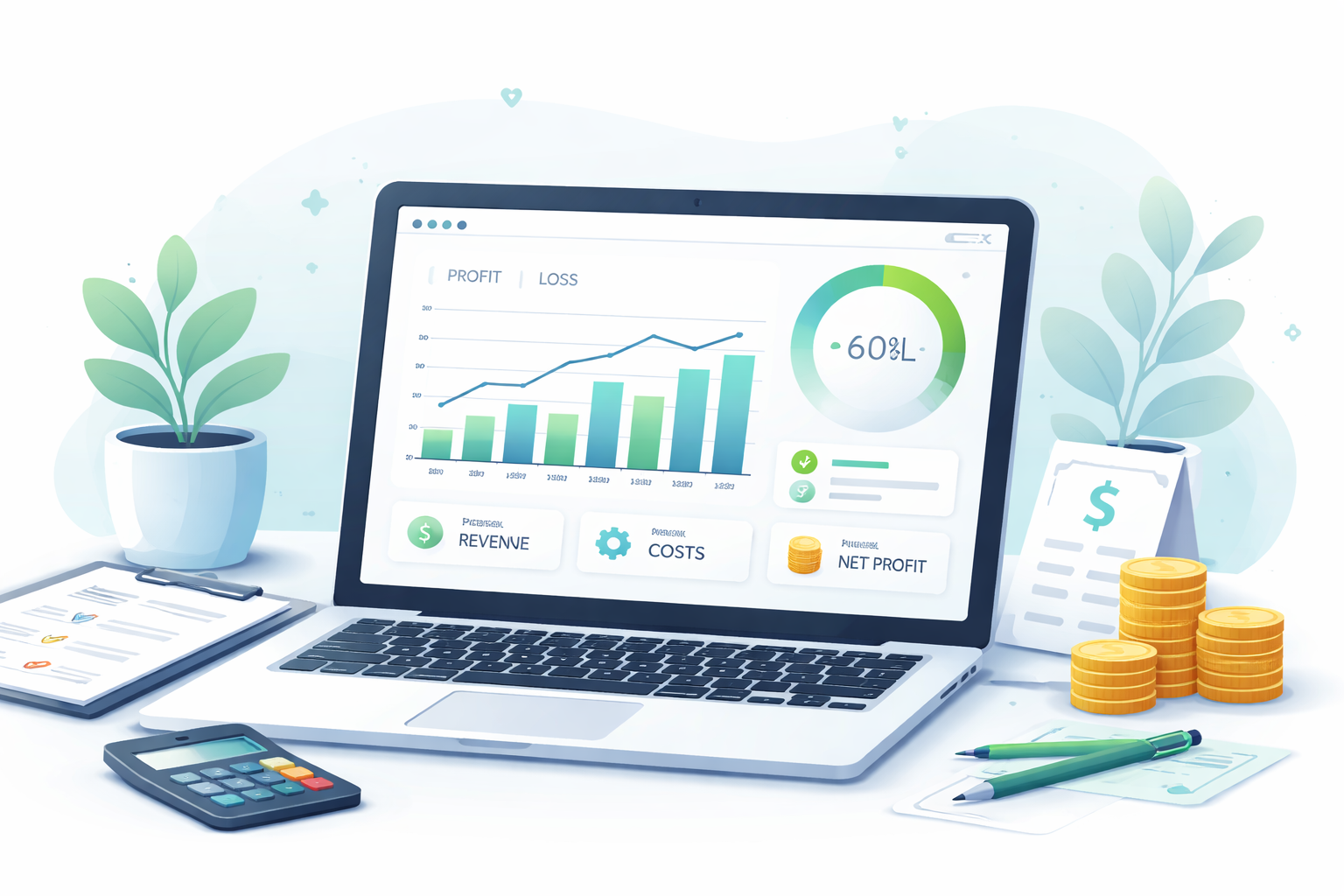
The Profit & Loss report is one of the most important documents in your business, but for many owners it feels confusing, overly technical, or disconnected from reality. You open it, see numbers moving up and down, and still walk away unsure what actually changed or what action to take. This is not a lack of intelligence or effort — it is a lack of structure in how the report is read.
A P&L is not just a list of income and expenses. It is a story about how your business generates revenue, how much it costs to deliver that revenue, and how efficiently the business is run. When read correctly, it answers practical questions: Are we pricing correctly? Are costs under control? Is growth actually profitable?
The key is to stop reading it line by line and start reading it in blocks. Revenue, cost of goods sold, and operating expenses each tell a different part of the story. Together, they show whether your business model works and whether your current decisions are sustainable.
This guide breaks the report into simple sections, explains what “good” looks like, and shows you how to interpret changes without needing a financial background. The goal is not to turn you into a technical expert, but to give you clarity and control over your numbers.
We will also go through realistic scenarios, common mistakes, and a checklist you can use every month. By the end, you should be able to look at your P&L and immediately understand what matters and what to do next.
What the P&L Shows (and What It Does Not)
The Profit & Loss report shows your revenue, expenses, and resulting profit for a specific period. It answers one core question: did your business generate profit during this time? It does this by matching income and expenses, even if cash was not actually received or paid yet.
This is important to understand because the P&L is not a cash report. You can show strong profit while your bank account is low, or show low profit while your cash position is stable. The report reflects performance, not liquidity.
For a complete picture, you should always read the P&L together with your bank balances and receivables. If you want to understand this deeper, see our article on cash flow vs profit.
Once you accept that the P&L is about performance, not cash, it becomes a much more powerful decision-making tool.
Revenue Section: What to Look For
Revenue is the top line of your report. It shows how much your business generated in sales during the period. The first thing to look at is not just the number itself, but the trend. Is revenue growing, stable, or declining?
However, growth alone is not enough. You should also look at how revenue is generated. Are you relying on a few large clients? Are discounts increasing? Are payment terms changing? These details affect both profit and cash flow.
Another important factor is consistency. Sudden spikes or drops often indicate one-time events, not sustainable growth. Understanding this helps you avoid making decisions based on temporary changes.
Fix this in your books
If you’re not sure where to start, we can help. We’ll review your current bookkeeping setup, identify any gaps or issues, and give you a clear plan to fix it — just straightforward advice.
Cost of Goods Sold (COGS): Your Direct Costs
COGS includes the direct costs required to deliver your product or service. This may include materials, subcontractors, or direct labor. This section directly impacts your gross margin, which is one of the most important indicators in your business.
Gross margin is calculated as revenue minus COGS. It shows how much money is left after covering the direct cost of delivering your service. A stable or improving gross margin usually indicates better pricing or efficiency.
If revenue grows but COGS grows faster, your margins shrink. This is a warning sign that your business may be working harder without actually becoming more profitable.
Operating Expenses: The Cost of Running the Business
Operating expenses include everything required to run your business but not directly tied to delivering the service. This includes rent, software, marketing, administrative costs, and more.
These costs should grow in a controlled way. If overhead increases too quickly, it can eat into profit even when revenue is growing. The key is to track how these expenses behave relative to revenue.
A well-managed business keeps overhead aligned with growth, not ahead of it.
Scenario 1: Revenue Up, Profit Down
Imagine your revenue increases from $40,000 to $55,000. At first glance, this looks like strong growth. However, your COGS increases from $15,000 to $30,000 due to higher subcontractor costs, discounts, and processing fees.
Your gross margin drops significantly, and your final profit decreases despite higher revenue. The business is busier, but less efficient.
This scenario often happens when pricing is not adjusted, discounts are used too aggressively, or costs increase without control. Without reviewing margins, the owner may incorrectly assume the business is improving.
The key takeaway is simple: revenue growth must be evaluated together with margins, not in isolation.
Scenario 2: Profit Looks Great, but You Feel Broke
Your P&L shows a monthly profit of $12,000. On paper, everything looks strong. However, your bank account feels tight, and you are relying on credit cards to manage expenses.
This happens because revenue is recorded when invoices are issued, not when cash is received. At the same time, expenses are paid immediately, often using credit cards that create a temporary “float.”
As a result, the report shows profit, but your cash position does not reflect it yet. This creates a disconnect between what you see and what you feel.
This is why understanding both P&L and cash flow is essential. You can explore this deeper in our cash flow article.
What “Good” Looks Like
There is no universal perfect number, but there are patterns that indicate a healthy structure. Revenue should grow steadily and not rely on one-time spikes. It should be predictable enough to support planning and decision-making.
COGS should remain controlled relative to revenue. If costs increase, there should be a clear reason such as higher volume or strategic investment. Sudden increases without explanation are a warning sign.
Operating expenses should grow slower than revenue over time. This creates operating leverage, where additional revenue contributes more to profit.
Consistency is often more important than absolute numbers. Stable trends indicate a business that is under control.
10 Questions Every Owner Should Ask
Is revenue growth consistent, or is it driven by one-time events that may not repeat?
Is gross margin stable, improving, or declining, and what specifically caused the change?
Are direct costs increasing faster than revenue, and if so, why?
Are discounts or fees affecting profitability more than expected?
Are operating expenses aligned with current business size and growth stage?
Which expenses increased this month, and are they justified or temporary?
Does the profit shown reflect actual performance, or are there timing differences involved?
Are there any unusual or one-time transactions affecting this month’s results?
How does this month compare to previous months in both structure and performance?
What specific action should be taken based on this report?
How to Review Your P&L Each Month
A good monthly review is not about reading every line. It is about identifying changes and understanding their causes. Start with revenue, then move to margins, and finally review expenses.
Focus on what changed compared to the previous month or the same month last year. Changes are where insights are found.
Use your P&L together with your bank data. This gives you both performance and reality.
If you want structured support, see our services, pricing, or explore more in our blog.
FAQ
What is the difference between gross and net profit?
Gross profit is revenue minus direct costs. Net profit is what remains after all expenses are deducted.
Where does owner pay appear?
It depends on the structure. In some cases it is an expense, in others it is a distribution.
How should I treat one-time expenses?
They should be identified separately so they do not distort your understanding of regular performance.
Why does my P&L change after month close?
Adjustments, late entries, or corrections can update the report after initial review.
How often should I review it?
At least monthly, with weekly awareness of key metrics if possible.
What should I bring to a monthly review call?
Bring your questions, recent changes in operations, and awareness of any unusual transactions.